Goa-AI Framework

Design-first framework for building agentic, tool-driven systems in Go.

Overview

Goa-AI extends Goa’s design-first philosophy to agentic systems. Define agents, toolsets, service-owned completions, and policies in a DSL; generate production-ready code with typed contracts, durable workflows, and streaming events.


Why Goa-AI?

Design-First Agents

Stop writing brittle agent code. Start with contracts.

Most agent frameworks have you wiring together prompts, tools, and API calls imperatively. When things break—and they will—you’re debugging scattered code with no clear source of truth.

Goa-AI flips this: define your agent’s capabilities in a typed DSL, then generate the implementation. Your design is your documentation. Your contracts are your validation. Changes propagate automatically.

Agent("assistant", "A helpful coding assistant", func() {
    Use("code_tools", func() {
        Tool("analyze", "Analyze code for issues", func() {
            Args(func() {
                Attribute("code", String, "Source code to analyze", func() {
                    MinLength(1)           // Can't be empty
                    MaxLength(100000)      // Reasonable size limit
                })
                Attribute("language", String, "Programming language", func() {
                    Enum("go", "python", "javascript", "typescript", "rust", "java")
                })
                Required("code", "language")
            })
            Return(AnalysisResult)
        })
    })
})

When planner code builds this call with planner.NewToolRequest, generated encoding errors return directly to the planner. When a model emits schema-invalid arguments - say, an empty code string or language: "cobol" - the validated model client returns model.OutputValidationError; the planner/runtime surfaces planner.OutputContractError before executor or service code runs.

ToolFailure and RecoveryCorrectCall apply later: a model-authored call must first pass validation and be admitted, then its executor or domain boundary must return a recoverable failure. The runtime uses that failure to guide the next planner turn without ad-hoc string parsing or hand-maintained JSON schema.

Benefits:

  • Single source of truth — The DSL defines behavior, types, and documentation
  • Compile-time safety — Catch mismatched payloads before runtime
  • Auto-generated clients — Type-safe tool invocations without manual wiring
  • Consistent patterns — Every agent follows the same structure
  • Repairable execution failures — Admitted model-authored calls can return typed failure details and recovery directives

→ Learn more in the DSL Reference and Quickstart


Generated Evaluations

Your agent changed. Did its answers get worse?

Evaluations are repeatable tests that run your real agent and check the outcome is still correct. Most teams hand-build that harness: YAML case files, a bespoke runner, and regular expressions trying to match model answers. Goa-AI generates the harness from the same design that defines the agent:

Agent("chat", "Answers product questions.", func() {
    Suite("chat", func() {
        Description("Exercises production Chat outcomes.")
        Timeout("2m")
        Scenario("alarm_inventory", func() {
            Description("Retrieves every alarm in a fixed window.")
            Input(ChatEvalInput)          // typed, validated scenario input
            Tags("production", "alarm")
        })
    })
})

goa gen turns each scenario into a typed Go interface method — adding a scenario breaks the build until the application implements it. goa example creates a runnable cmd/<suite>-evals command once. Hooks return exact pass/fail checks plus plain-English claims about the model’s answer; a model-backed judge grades each claim, but only after passing a calibration test proving it can tell correct from incorrect answers.

Benefits:

  • Design-owned scenarios — Test cases live beside the agent they test, with typed, validated inputs
  • No silent drift — A scenario without an implementation is a compile error, not a skipped test
  • No regex grading — Plain-English claims judged by a calibrated model replace answer pattern-matching
  • CI-ready — Scenario and tag selection flags, bounded concurrency, stable JSON reports in design order

→ Learn more in Generated Evaluations


Typed Direct Completions

Not every structured interaction should be a tool call.

Sometimes the right contract is a typed final assistant answer: no tool invocation, no handwritten JSON parsing, no parallel schema definition hidden in prompt text.

Goa-AI models that explicitly with Completion(...) on a service:

var TaskDraft = Type("TaskDraft", func() {
    Attribute("name", String, "Task name")
    Attribute("goal", String, "Outcome-style goal")
    Required("name", "goal")
})

var _ = Service("tasks", func() {
    Completion("draft_from_transcript", "Produce a task draft directly", func() {
        Return(TaskDraft)
    })
})

Completion names are part of the structured-output contract. They must be 1-64 ASCII characters, may contain letters, digits, _, and -, and must start with a letter or digit.

Codegen emits gen/<service>/completions/ with private schema and codec details plus public typed helpers. Unary helpers return the accepted typed value. Streaming helpers return completion.Streamer[T]: Recv yields preview-only completion_delta fragments, and Value() returns the typed result only after the provider closes a valid stream. Providers that do not implement structured output fail explicitly with model.ErrStructuredOutputUnsupported; malformed output fails with a non-retryable planner.OutputContractError.

Benefits:

  • One contract surface — Reuse Goa types, validations, and OneOf for direct assistant output
  • No hand-parsed JSON — Generated codecs own encoding, decoding, and validation
  • Provider-neutral structured output — The helper hides provider wiring behind a typed API

→ Learn more in the DSL Reference and Runtime


Run Trees

Build complex systems from simple, observable pieces.

Real-world AI applications aren’t single agents—they’re orchestrated workflows where agents delegate to other agents, tools spawn sub-tasks, and you need to trace everything.

Goa-AI’s run tree model gives you hierarchical execution with full observability. Each agent run has a unique ID. Child runs link to parents. Events stream in real-time. Debug any failure by walking the tree.

Hierarchical agent execution with run trees showing parent-child relationships

Benefits:

  • Agent-as-tool — Any agent can be invoked as a tool by another agent
  • Hierarchical tracing — Follow execution across agent boundaries
  • Isolated failures — Child runs fail independently; parents can retry or recover
  • Streaming topology — Events flow up the tree for real-time UIs

→ Deep dive in Agent Composition and Runtime


Structured Streaming

Real-time visibility into every decision your agents make.

Black-box agents are a liability. When your agent calls a tool, starts thinking, or encounters an error, you need to know immediately—not after the request times out.

Goa-AI emits typed events throughout execution: assistant_reply for streaming text, tool_start/tool_end for tool lifecycle, planner_thought for reasoning visibility, usage for token tracking. Events flow through a simple Sink interface to any transport, and production UIs consume a single session-owned stream (session/<session_id>) and close when they observe run_stream_end for the active run.

// Wire a sink at startup — all events from all runs flow through it
rt := runtime.New(runtimeStore, runtime.WithStream(mySink))

Stream profiles filter events for different consumers: UserChatProfile() for end-user UIs, AgentDebugProfile() for developer views, MetricsProfile() for observability pipelines. Built-in sinks for Pulse (Redis Streams) enable distributed streaming across services.

Benefits:

  • Transport-agnostic — Same events work over WebSocket, SSE, Pulse, or custom backends
  • Typed contracts — No string parsing; events are strongly typed with documented payloads
  • Selective delivery — Stream profiles filter events per consumer
  • Multi-tenant ready — Events carry RunID and SessionID for routing and filtering

→ Implementation details in Production Streaming


Temporal Durability

Agent runs that survive crashes, restarts, and network failures.

Without durability, a crashed process loses all progress. A rate-limited API call fails the entire run. A network blip during tool execution means re-running expensive inference.

Goa-AI uses Temporal for durable execution. Agent runs become workflows; tool calls become activities with configurable retries. Every state transition is persisted. A crashed tool retries automatically—without re-running the LLM call that produced it.

// Development: in-memory (no dependencies)
rt := runtime.New(storageinmem.New())

// Production: Temporal for durability
eng, err := temporal.NewWorker(temporal.Options{
    ClientOptions: &client.Options{HostPort: "localhost:7233"},
    WorkerOptions: temporal.WorkerOptions{TaskQueue: "my-agents"},
})
if err != nil {
    panic(err)
}
defer eng.Close()
rt := runtime.New(runtimeStore, runtime.WithEngine(eng))

Benefits:

  • No wasted inference — Failed tools retry without re-calling the LLM
  • Crash recovery — Restart workers anytime; runs resume from last checkpoint
  • Rate limit handling — Exponential backoff absorbs API throttling
  • Version-aware deployment — Follow the Production rollout contract for compatible rolling releases and incompatible generated changes

→ Setup guide and retry configuration in Production


Tool Registries

Discover and consume tools from anywhere—your cluster or the public cloud.

As AI ecosystems grow, tools are everywhere: internal services, third-party APIs, public MCP registries. Hardcoding tool definitions doesn’t scale. You need dynamic discovery.

Goa-AI provides a clustered internal registry for your own toolsets and federation with external registries like Anthropic’s MCP catalog. Define once, discover everywhere.

// Connect to public registries
var AnthropicRegistry = Registry("anthropic", func() {
    Description("Anthropic MCP Registry")
    URL("https://registry.anthropic.com/v1")
    Security(AnthropicOAuth)
    Federation(func() {
        Include("web-search", "code-execution", "filesystem")
        Exclude("experimental/*")
    })
    SyncInterval("1h")
    CacheTTL("24h")
})

// Or run your own clustered registry
var CorpRegistry = Registry("corp", func() {
    Description("Internal tool registry")
    URL("https://registry.corp.internal")
    Security(CorpAPIKey)
    SyncInterval("5m")
})

Internal Registry Clustering:

Multiple registry nodes with the same name automatically form a cluster via Redis. Shared state, coordinated health checks, horizontal scaling—all automatic.

Agent-registry-provider topology showing gRPC and Pulse Streams connections

Benefits:

  • Dynamic discovery — Agents find tools at runtime, not compile time
  • Multi-cluster scaling — Registry nodes auto-coordinate via Redis
  • Public registry federation — Import tools from Anthropic, OpenAI, or any MCP registry
  • Health monitoring — Automatic ping/pong checks with configurable thresholds
  • Selective import — Include/exclude patterns for granular control

→ Learn more in MCP Integration and Production


Key Features Summary

FeatureWhat You Get
Design-First AgentsDefine agents in DSL, generate type-safe code
Generated EvaluationsDesign-declared test scenarios, typed hooks, calibrated model-graded reports
MCP IntegrationNative Model Context Protocol support
Tool RegistriesClustered discovery + public registry federation
Run TreesAgents calling agents with full traceability
Structured StreamingReal-time typed events for UIs and observability
Temporal DurabilityFault-tolerant execution that survives failures
Runtime StorageOne host-owned store for run state, continuation checkpoints, and records that never change after insertion
Typed ContractsEnd-to-end type safety for all tool operations
Typed Direct CompletionsStructured final assistant answers with generated codecs and helpers
Bounded Results & Server DataToken-efficient model results plus server-only data for UIs and audit
Human-in-the-LoopPause, resume, external tool results, and runtime-enforced confirmation
Bookkeeping & Terminal ToolsProgress/status tools that do not consume retrieval budget and can end runs atomically
Prompt OverridesBaseline prompt specs plus scoped Mongo-backed overrides and provenance

Documentation Guides

GuideDescription~Tokens
QuickstartInstallation and first agent~2,700
DSL ReferenceComplete DSL: agents, toolsets, policies, MCP~3,600
RuntimeRuntime architecture, plan/execute loop, engines~2,400
ToolsetsToolset types, execution models, transforms~2,300
Agent CompositionAgent-as-tool, run trees, streaming topology~1,400
Generated EvaluationsTyped eval suites, scenario hooks, judge calibration, reports~2,600
MCP IntegrationMCP servers, transports, generated wrappers~1,200
Memory & SessionsTranscripts, memory stores, sessions, runs~1,600
ProductionTemporal setup, streaming UI, model integration~2,200
Testing & TroubleshootingTesting agents, planners, tools, common errors~2,000

Total Section: ~24,000 tokens

Architecture

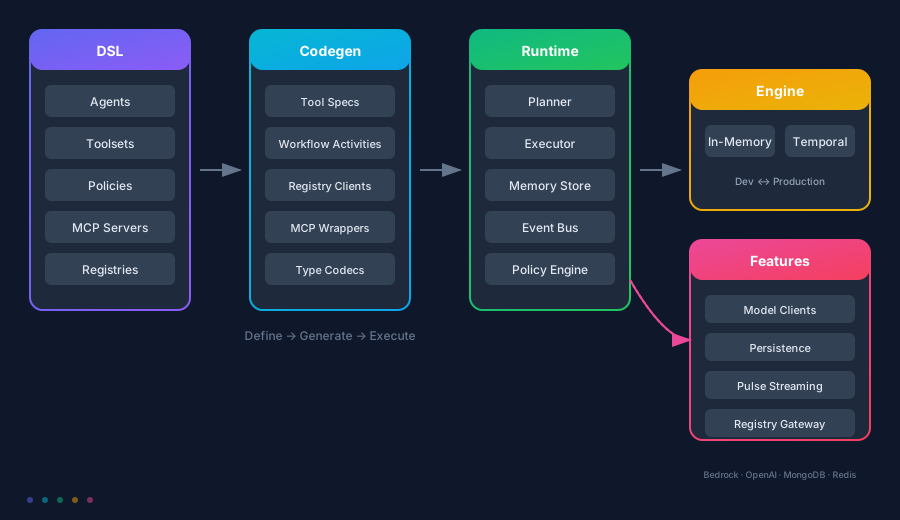
Goa-AI follows a define → generate → execute pipeline that transforms declarative designs into production-ready agent systems.

Goa-AI Architecture

Layer Overview:

LayerPurpose
DSLDeclare agents, tools, policies, and external integrations in version-controlled Go code
CodegenGenerate type-safe specs, codecs, workflow definitions, and registry clients—never edit gen/
RuntimeExecute the plan/execute loop with policy enforcement, required host-owned runtime storage, optional product memory, and event streaming
EngineSwap execution backends: in-memory for development, Temporal for production durability
FeaturesPlug in model providers (OpenAI, Anthropic, AWS Bedrock, Google Vertex AI), product memory and prompt persistence, streaming (Pulse), and registries

Key Integration Points:

  • Model Clients — Abstract LLM providers behind a unified interface; switch between OpenAI, Anthropic, Bedrock, or Vertex AI (Gemini or Claude-on-Vertex) without changing agent code
  • Registry — Discover and invoke toolsets across process boundaries; clustered via Redis for horizontal scaling
  • Pulse Streaming — Real-time event bus for UI updates, observability pipelines, and cross-service communication
  • Temporal Engine — Durable workflow execution with activity retries, replay, and crash recovery

Model Providers & Extensibility

Goa-AI ships first-class adapters for four LLM providers:

  • OpenAI (features/model/openai)
  • Anthropic Claude (features/model/anthropic)
  • AWS Bedrock (features/model/bedrock)
  • Google Vertex AI (features/model/vertex) — a native Gemini adapter plus a pure-construction helper for Claude models hosted on Vertex (which delegates translation and error classification to features/model/anthropic)

All four expose the same opaque model.Client used by planners. Applications register model clients with the runtime using rt.RegisterModel("provider-id", client) and refer to them by ID from planners and generated agent configs, so swapping providers is a configuration change rather than a redesign. Goa-AI validates every request and complete response before application code can observe it.

Gemini 3-class models attach an opaque thought signature to tool-call (functionCall) parts to authenticate the reasoning that produced them. The runtime captures and reattaches this signature entirely on its own side — it is never exposed on planner-facing types — so planner code is identical whether or not the configured model uses this feature. See Runtime → LLM Integration for details.

Adding a new provider follows the same pattern:

  1. Implement model.Provider by mapping the provider SDK onto model.Request, model.Response, and raw transport chunks.
  2. Construct the validated client with model.NewClient(provider). Install provider middleware with model.WrapClient; external packages cannot implement or bypass model.Client.
  3. Call rt.RegisterModel("my-provider", client), then reference "my-provider" from planners or agent configs.

Because planners and the runtime depend only on the validated model.Client, new providers plug in without changes to Goa designs or generated agent code. See Runtime → LLM Integration for request and response limits, provider capability differences, remote model gateways, and coordinated upgrade requirements.

Quick Example

package design

import (
    . "goa.design/goa/v3/dsl"
    . "goa.design/goa-ai/dsl"
)

var _ = Service("calculator", func() {
    Description("Calculator service with an AI assistant")
    
    // Define a service method that the tool will bind to
    Method("add", func() {
        Description("Add two numbers")
        Payload(func() {
            Attribute("a", Int, "First number")
            Attribute("b", Int, "Second number")
            Required("a", "b")
        })
        Result(Int)
    })
    
    // Define the agent within the service
    Agent("assistant", "A helpful assistant agent", func() {
        // Use a toolset with tools bound to service methods
        Use("calculator", func() {
            Tool("add", "Add two numbers", func() {
                Args(func() {
                    Attribute("a", Int, "First number")
                    Attribute("b", Int, "Second number")
                    Required("a", "b")
                })
                Return(Int)
                BindTo("add")  // Bind to the service method
            })
        })
        
        // Configure the agent's run policy
        RunPolicy(func() {
            DefaultCaps(MaxToolCalls(10))
            TimeBudget("5m")
        })
    })
})

Getting Started

Start with the Quickstart guide to install Goa-AI and build your first agent.

For comprehensive DSL coverage, see the DSL Reference.

For understanding the runtime architecture, see the Runtime guide.

In This Section

Quickstart

Build a working AI agent in 10 minutes. Start with a stub, add streaming, validation, then connect a real LLM.

DSL Reference

Complete reference for Goa-AI’s DSL functions - agents, toolsets, policies, and MCP integration.

Runtime

Understand how the Goa-AI runtime orchestrates agents, enforces policies, and manages state.

Toolsets

Learn about toolset types, execution models, validation, structured failure recovery, and tool catalogs in Goa-AI.

Agent Composition

Learn how to compose agents using agent-as-tool patterns, run trees, and streaming topology.

Generated Evaluations

Declare agent test scenarios in your Goa design, implement one typed hook per scenario, and get calibrated, model-graded reports.

MCP Integration

Integrate external MCP servers into your agents with generated wrappers and callers.

Memory & Sessions

Manage state with transcripts, memory stores, sessions, and runs in Goa-AI.

Production

Set up Temporal for durable workflows, stream events to UIs, apply adaptive rate limiting, and use system reminders.

Internal Tool Registry

Deploy a clustered gateway for cross-process toolset discovery and invocation.

Testing & Troubleshooting

Learn how to test agents, planners, and tools, and troubleshoot common issues.

Tool Payload Defaults

How Goa-AI applies Goa-style defaults to tool payloads (decode-body + transform) and what codegen contracts must hold.