Quickstart
Build a working AI agent in 10 minutes. Start with a stub, add streaming, validation, then connect a real LLM.
Goa-AI extends Goa’s design-first philosophy to agentic systems. Define agents, toolsets, and policies in a DSL; generate production-ready code with typed contracts, durable workflows, and streaming events.
Stop writing brittle agent code. Start with contracts.
Most agent frameworks have you wiring together prompts, tools, and API calls imperatively. When things break—and they will—you’re debugging scattered code with no clear source of truth.
Goa-AI flips this: define your agent’s capabilities in a typed DSL, then generate the implementation. Your design is your documentation. Your contracts are your validation. Changes propagate automatically.
Agent("assistant", "A helpful coding assistant", func() {
    Use("code_tools", func() {
        Tool("analyze", "Analyze code for issues", func() {
            Args(func() {
                Attribute("code", String, "Source code to analyze", func() {
                    MinLength(1)           // Can't be empty
                    MaxLength(100000)      // Reasonable size limit
                })
                Attribute("language", String, "Programming language", func() {
                    Enum("go", "python", "javascript", "typescript", "rust", "java")
                })
                Required("code", "language")
            })
            Return(AnalysisResult)
        })
    })
})
When the LLM calls this tool with invalid arguments—say, an empty code string or language: "cobol"—Goa-AI automatically retries with a validation error message. The LLM sees exactly what went wrong and corrects itself. No manual error handling code required.
Benefits:
→ Learn more in the DSL Reference and Quickstart
Build complex systems from simple, observable pieces.
Real-world AI applications aren’t single agents—they’re orchestrated workflows where agents delegate to other agents, tools spawn sub-tasks, and you need to trace everything.
Goa-AI’s run tree model gives you hierarchical execution with full observability. Each agent run has a unique ID. Child runs link to parents. Events stream in real-time. Debug any failure by walking the tree.

Benefits:
→ Deep dive in Agent Composition and Runtime
Real-time visibility into every decision your agents make.
Black-box agents are a liability. When your agent calls a tool, starts thinking, or encounters an error, you need to know immediately—not after the request times out.
Goa-AI emits typed events throughout execution: assistant_reply for streaming text, tool_start/tool_end for tool lifecycle, planner_thought for reasoning visibility, usage for token tracking. Events flow through a simple Sink interface to any transport, and production UIs consume a single session-owned stream (session/<session_id>) and close when they observe run_stream_end for the active run.
// Wire a sink at startup — all events from all runs flow through it
rt := runtime.New(runtime.WithStream(mySink))
Stream profiles filter events for different consumers: UserChatProfile() for end-user UIs, AgentDebugProfile() for developer views, MetricsProfile() for observability pipelines. Built-in sinks for Pulse (Redis Streams) enable distributed streaming across services.
Benefits:
RunID and SessionID for routing and filtering→ Implementation details in Production Streaming
Agent runs that survive crashes, restarts, and network failures.
Without durability, a crashed process loses all progress. A rate-limited API call fails the entire run. A network blip during tool execution means re-running expensive inference.
Goa-AI uses Temporal for durable execution. Agent runs become workflows; tool calls become activities with configurable retries. Every state transition is persisted. A crashed tool retries automatically—without re-running the LLM call that produced it.
// Development: in-memory (no dependencies)
rt := runtime.New()

// Production: Temporal for durability
eng, _ := temporal.NewWorker(temporal.Options{
    ClientOptions: &client.Options{HostPort: "localhost:7233"},
    WorkerOptions: temporal.WorkerOptions{TaskQueue: "my-agents"},
})
rt := runtime.New(runtime.WithEngine(eng))
Benefits:
→ Setup guide and retry configuration in Production
Discover and consume tools from anywhere—your cluster or the public cloud.
As AI ecosystems grow, tools are everywhere: internal services, third-party APIs, public MCP registries. Hardcoding tool definitions doesn’t scale. You need dynamic discovery.
Goa-AI provides a clustered internal registry for your own toolsets and federation with external registries like Anthropic’s MCP catalog. Define once, discover everywhere.
// Connect to public registries
var AnthropicRegistry = Registry("anthropic", func() {
    Description("Anthropic MCP Registry")
    URL("https://registry.anthropic.com/v1")
    Security(AnthropicOAuth)
    Federation(func() {
        Include("web-search", "code-execution", "filesystem")
        Exclude("experimental/*")
    })
    SyncInterval("1h")
    CacheTTL("24h")
})

// Or run your own clustered registry
var CorpRegistry = Registry("corp", func() {
    Description("Internal tool registry")
    URL("https://registry.corp.internal")
    Security(CorpAPIKey)
    SyncInterval("5m")
})
Internal Registry Clustering:
Multiple registry nodes with the same name automatically form a cluster via Redis. Shared state, coordinated health checks, horizontal scaling—all automatic.

Benefits:
→ Learn more in MCP Integration and Production
| Feature | What You Get |
|---|---|
| Design-First Agents | Define agents in DSL, generate type-safe code |
| MCP Integration | Native Model Context Protocol support |
| Tool Registries | Clustered discovery + public registry federation |
| Run Trees | Agents calling agents with full traceability |
| Structured Streaming | Real-time typed events for UIs and observability |
| Temporal Durability | Fault-tolerant execution that survives failures |
| Typed Contracts | End-to-end type safety for all tool operations |
| Guide | Description | ~Tokens |
|---|---|---|
| Quickstart | Installation and first agent | ~2,700 |
| DSL Reference | Complete DSL: agents, toolsets, policies, MCP | ~3,600 |
| Runtime | Runtime architecture, plan/execute loop, engines | ~2,400 |
| Toolsets | Toolset types, execution models, transforms | ~2,300 |
| Agent Composition | Agent-as-tool, run trees, streaming topology | ~1,400 |
| MCP Integration | MCP servers, transports, generated wrappers | ~1,200 |
| Memory & Sessions | Transcripts, memory stores, sessions, runs | ~1,600 |
| Production | Temporal setup, streaming UI, model integration | ~2,200 |
| Testing & Troubleshooting | Testing agents, planners, tools, common errors | ~2,000 |
Total Section: ~21,400 tokens
Goa-AI follows a define → generate → execute pipeline that transforms declarative designs into production-ready agent systems.
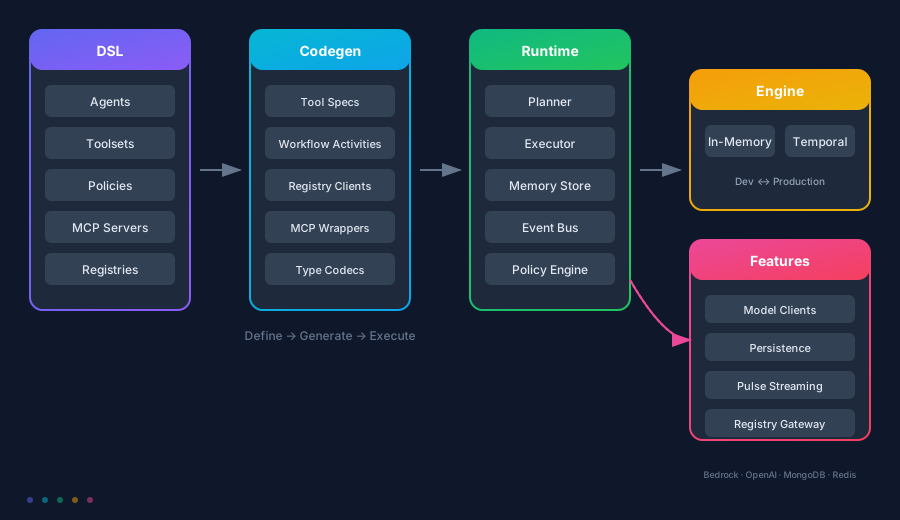
Layer Overview:
| Layer | Purpose |
|---|---|
| DSL | Declare agents, tools, policies, and external integrations in version-controlled Go code |
| Codegen | Generate type-safe specs, codecs, workflow definitions, and registry clients—never edit gen/ |
| Runtime | Execute the plan/execute loop with policy enforcement, memory persistence, and event streaming |
| Engine | Swap execution backends: in-memory for development, Temporal for production durability |
| Features | Plug in model providers (OpenAI, Anthropic, AWS Bedrock), persistence (Mongo), streaming (Pulse), and registries |
Key Integration Points:
Goa-AI ships first-class adapters for three LLM providers:
features/model/openai)features/model/anthropic)features/model/bedrock)All three implement the same model.Client interface used by planners. Applications register model clients with the runtime using rt.RegisterModel("provider-id", client) and refer to them by ID from planners and generated agent configs, so swapping providers is a configuration change rather than a redesign.
Adding a new provider follows the same pattern:
model.Client for your provider by mapping its SDK types onto model.Request, model.Response, and streaming model.Chunks.features/model/middleware.NewAdaptiveRateLimiter) for adaptive rate limiting and metrics.rt.RegisterModel("my-provider", client) before registering agents, then reference "my-provider" from your planners or agent configs.Because planners and the runtime depend only on model.Client, new providers plug in without changes to your Goa designs or generated agent code.
package design

import (
    . "goa.design/goa/v3/dsl"
    . "goa.design/goa-ai/dsl"
)

var _ = Service("calculator", func() {
    Description("Calculator service with an AI assistant")

    // Define a service method that the tool will bind to
    Method("add", func() {
        Description("Add two numbers")
        Payload(func() {
            Attribute("a", Int, "First number")
            Attribute("b", Int, "Second number")
            Required("a", "b")
        })
        Result(Int)
    })

    // Define the agent within the service
    Agent("assistant", "A helpful assistant agent", func() {
        // Use a toolset with tools bound to service methods
        Use("calculator", func() {
            Tool("add", "Add two numbers", func() {
                Args(func() {
                    Attribute("a", Int, "First number")
                    Attribute("b", Int, "Second number")
                    Required("a", "b")
                })
                Return(Int)
                BindTo("add")  // Bind to the service method
            })
        })

        // Configure the agent's run policy
        RunPolicy(func() {
            DefaultCaps(MaxToolCalls(10))
            TimeBudget("5m")
        })
    })
})
Start with the Quickstart guide to install Goa-AI and build your first agent.
For comprehensive DSL coverage, see the DSL Reference.
For understanding the runtime architecture, see the Runtime guide.